

News & Events
Displaying 49 - 55 of 55
Displaying 49 - 55 of 55
Courtney Green Awarded CESERT Robotic Grant from Association for Surgical Education (ASE) Foundation
General Surgery Residency Program
December 27, 2017
Courtney A. Green, M.D., research fellow in the General Surgery Residency program, has been awarded a CSERT (Center for Excellence in Surgical Education, Research and Training) grant from the Association for Surgical Education (ASE) Foundation. Her research project is entitled, “Investigation into the Perceptual...
Quan-Yang Duh Receives 2017 Paul Starr Award from American Thyroid Association
UCSF Endocrine Surgery
December 20, 2017
Quan-Yang Duh M.D., professor and chief of endocrine surgery at UCSF, and a nationally and internationally recognized leader in the field, is the recipient of the 2017 Paul Starr Award from the American Thyroid Association (ATA). The Paul Starr Award Lecture recognizes an outstanding contributor to clinical...
UCSF Department of Surgery Faculty Honored with Excellence in Teaching Awards
UCSF Department of Surgery
October 02, 2017
The Haile T. Debas Academy of Medical Educators presented seven Department of Surgery faculty with the Excellence in Teaching Award for 2017 at a ceremony on September 11th at the UCSF School of Nursing, held in conjunction with the Academy's induction of new members. The Academy's Excellence in Teaching Awards...
Eric Nakakura and Research Group Awarded $1.2M Grant to Study Small Intestinal Neuroendocrine Tumors
UCSF Surgical Oncology Program
June 03, 2017
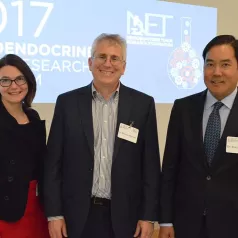
Eric Nakakura, M.D., Ph.D. , Associate Professor of Surgery at UCSF and a leading authority on neuroendocrine tumors of the gastrointestinal tract and pancreas, is among a team of researchers awarded $1.2M grant by the Neuroendocrine Tumor Research Foundation (NETRF) to elucidate the causes of small intestinal...
Garry Shandling and the Disease You Didn’t Know About
UCSF Endocrine Surgery
April 07, 2016
James Fallows, national correspondent for The Atlantic, recently wrote about the death of comedian Garry Shandling, noting that he suffered from hyperparathyroidism, a condition that, if left untreated, can raise the risk of having a heart attack and other serious medical conditions. Fallows' piece was both...
Bilateral Adrenal Incidentalomas May Have Different Etiology Than Unilateral
UCSF Endocrine Surgery
October 01, 2015
MedicalResearch.com recently interviewed Quan-Yang Duh M.D. (pictured first), Chief of the Section of Endocrine Surgery, Division of General Surgery, at UCSF, on the differences in etiology of unilateral vs. bilateral incidentalomas. What we found in our study was that although the possible subclinical diseases...
Presence Of Gene Mutation Helps Guide Thyroid Cancer Treatment
UCSF Endocrine Surgery
September 06, 2007
"A specific gene mutation may be useful in predicting the level of aggression of thyroid cancer and help guide treatment options and follow-up care, according to new study findings. The mutation, called BRAF V600E, is a genetic alteration in the BRAF oncogene, a modified gene believed to cause cancer. ......."